Drain Cleaning in Westchester County, NY
Clearing the clog is the easy part. We also tell you why it happened, so you’re not calling someone about the same drain again in three months.
- Licensed & Insured
- Same-Day Service Available
- Upfront Pricing
- Clean, Respectful Technicians
Signs it’s more than one slow drain
A single sink draining slowly is usually a local problem — something caught in that fixture’s own trap or branch line. Annoying, but small.
What matters is telling that apart from a problem further down the system, because the second kind gets worse and can back up into your house. These are the signs it isn’t local:
- More than one fixture is slow at the same time. Two bathrooms, or a sink and a tub together, points at shared pipework rather than either fixture.
- Using one fixture affects another. Flushing a toilet and hearing the tub gurgle, or a washing machine draining and water rising in a floor drain, is a classic sign of a restriction downstream.
- The lowest drain in the house acts up first. Basement floor drains and ground-floor showers are where a main line problem shows itself before anywhere else.
- It keeps coming back. A drain that clears and re-clogs every few months isn’t really being fixed — something is still in there.
- Smell. A persistent sewer smell suggests a partial blockage holding waste in the line, or a dry trap.
If several drains are slow at once, treat it as the main line until proven otherwise. That one is worth a call sooner rather than later.
What’s usually causing it
Clogs here follow fairly predictable patterns, and where the drain is tells you a lot about what’s in it.
Kitchen lines
Grease, almost always. It goes down warm and liquid, cools in the pipe, and sets on the walls of the line. Every subsequent bit of food waste sticks to it. Cold winters and long runs of pipe through unheated basements make this worse here than in warmer climates, because the line the grease is cooling in is genuinely cold.
Bathroom lines
Hair bound together with soap scum, sitting in the trap or just past it. Simple, and usually reachable.
Older cast iron and clay
A good number of homes in this area still have their original cast iron waste stacks or clay sewer laterals. Cast iron scales up internally over decades, narrowing the pipe and giving debris something to catch on. Clay joints shift.
Tree roots
Mature trees are one of the pleasures of living here and one of the hazards of the sewer lateral underneath them. Roots find the small amount of moisture at a pipe joint and work in. This is a slow, seasonal pattern rather than a sudden blockage, and it’s worth seeing inside the line rather than repeatedly clearing something that keeps growing back.
What to try yourself — and what to skip
We’d rather you solved a simple clog yourself than paid us to do something you could have done in ten minutes. Here’s the honest version.
Worth trying
- Clean the pop-up or strainer. On a bathroom sink, a startling amount of the problem is usually sitting right there.
- A plunger, properly. Fill the basin enough to cover the cup, block the overflow hole with a wet cloth, and use steady strokes. Most people give up too early.
- Very hot water and dish soap on a slow kitchen drain, if it’s early-stage grease.
- Cleaning the trap. If you’re comfortable, a bucket underneath and the trap unscrewed by hand solves a lot of bathroom and kitchen clogs outright.
Worth skipping
Chemical drain cleaners. This is the one we’d most like people to hear. They work by generating heat and a caustic reaction, which is fine on a light clog and genuinely damaging on a stubborn one — the chemical sits against older cast iron or a plastic trap and attacks it while the blockage stays put.
There’s also a safety side. If the drain doesn’t clear, the next person to open that trap is reaching into standing caustic liquid, and that includes us. The EPA’s Safer Choice guidance on household cleaning products is a reasonable place to start if you want gentler options for routine maintenance.
Salt, baking soda, and vinegar routines. These come up a lot online. Baking soda and vinegar produce a satisfying fizz that does almost nothing to established grease, and salt poured down nightly doesn’t dissolve a clog. They’re harmless, which is more than can be said for the chemicals — they just aren’t a fix, and time spent on them is time the problem continues.
Renting a powered auger for a main line. Powered cable in inexperienced hands can whip, damage older pipe, or get stuck fast in the line, which turns a drain-cleaning bill into an excavation bill.
Tried the simple things already?
Then it’s worth someone looking properly. Upfront pricing, no pressure.
How we actually clear it
- Work out where the blockage is first. Which fixtures are affected, and in what order, narrows it down before any equipment comes out of the van.
- Go in through the right access point. Usually a cleanout rather than the fixture itself, which means less dismantling and a straighter run at the blockage.
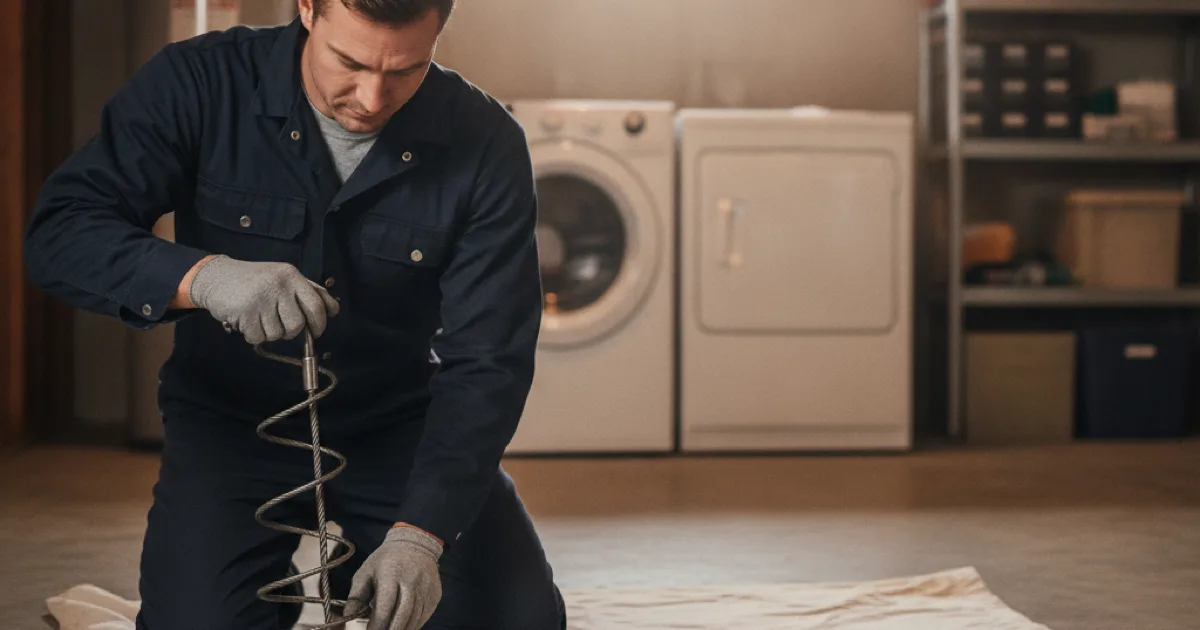
- Match the cable and head to the pipe. A head sized for a four-inch sewer line has no business in a sink branch, and the wrong head cuts a hole through a soft blockage instead of removing it — which is why some drains re-clog within weeks.
- Clear the full diameter, not just a channel. The goal is a pipe back to its actual size, not a passage through the middle of what’s still there.
- Run water and confirm. Properly, for long enough to be sure, on every affected fixture.
- Tell you what came out. Grease, roots, wipes, or a broken pipe are four different conversations about what happens next.
Where a line is heavily coated rather than plugged at one point, cabling reopens it but leaves the coating behind. That’s when jetting is the better option, because it scours the pipe wall rather than boring through the middle. We’ll say which one your line needs and why, rather than defaulting to the more expensive one.
When it isn’t a clog at all
Sometimes the drain is doing its best and the problem is elsewhere. Worth knowing, because clearing a drain that isn’t blocked achieves nothing.
- A blocked vent. Drains need air behind the water to flow. A vent blocked by a nest or debris causes slow draining and glugging across the house with no blockage in the waste line at all.
- A collapsed or offset pipe. Cable goes through, water still doesn’t flow properly, and it recurs quickly. This needs eyes on it, not more cabling.
- Bellied pipe. A section that has settled into a dip holds water and collects debris at the same spot forever. It will keep clogging in exactly the same place until the grade is corrected.
- A septic problem. On a septic system, whole-house slow draining can be the tank or field rather than the pipe. Clearing the line is the wrong fix and buys days at most.
This is the whole reason we tell you what came out of the line. Drain cleaning sits inside all of our drainage work, and if what you actually have is a pipe problem rather than a blockage, you deserve to hear that instead of a repeat visit every season. If you’d rather see everything from fixtures to sewer lines we handle, that’s all in one place.
Common questions
What do plumbers use instead of Drano?
Mechanical methods, mostly — a drain auger sized to the pipe, or a jetter for coated lines. The reason isn’t that chemicals never work; it’s that they don’t remove what’s causing the clog, they just try to dissolve a path through it. Cabling or jetting takes the material out, so the pipe is back to full diameter rather than temporarily open.
How much does drain cleaning cost?
It depends mainly on which line it is and how it’s accessed. A bathroom sink reached through its own trap is a small job; a main sewer line through an outside cleanout is a bigger one. You’ll get the price before we start, and if we find it’s a pipe problem rather than a clog we’ll stop and talk to you rather than continuing to bill.
My drain clears and then clogs again a month later. Why?
Usually one of three things: the blockage was bored through rather than removed, the line is coated along its length rather than plugged at a point, or there’s a physical defect — roots, a belly, a break — that keeps catching debris. Repeated clogs in the same place are a reason to look inside the pipe rather than clear it again.
Is it safe to keep using the bathroom if one drain is backing up?
If only that fixture is affected, yes, just stop using that one. If more than one is affected, or if water rises somewhere else when you flush, stop putting water into the system altogether until it’s been looked at — that’s the situation where a backup ends up on the floor.
Are “flushable” wipes actually flushable?
They clear the toilet, which is all the label really claims. They don’t break down like paper, and they catch on anything rough inside an older line — scaled cast iron, a root, a shifted joint. They’re a common find when we pull a main line blockage.
How often should drains be cleaned as maintenance?
Most homes don’t need scheduled drain cleaning at all. Where it does make sense is a line with a known history — roots in a lateral, or a restaurant-style grease load. Otherwise we’d rather you called when something changes than paid for a service you don’t need.
Let’s get it flowing again
Licensed, insured, and clear with you about what we found and what it means.