Drainage Services in Westchester County, NY
Water where you don’t want it usually has one of two causes, and they need two different trades. We’ll help you work out which one you’ve got before anyone starts charging you.
- Licensed & Insured
- Upfront Pricing
- Same-Day Service Available
- 15+ Years of Experience
Drains backing up or basement taking water?
Describe what you’re seeing and we’ll tell you who you need.
Inside the pipes, or outside the house?
Search for drainage help around here and you’ll get two completely different kinds of company back, mixed together, with nobody explaining the difference. It’s a genuinely confusing search, so here’s the distinction that matters.
Inside the pipes — that’s us
This is water that’s supposed to be in your plumbing and isn’t leaving properly. Sinks and tubs draining slowly, toilets backing up, a sewer line that’s blocked or broken, a floor drain that comes up instead of going down, a sump pump that isn’t keeping up. All plumbing work, and all things we do.
Outside the house — usually not us
This is surface and groundwater: a yard that stays soggy, water pooling against the foundation, a driveway that sheets toward the garage. The fixes are French drains, curtain drains, dry wells, regrading, and downspout extensions — excavation and landscape work rather than plumbing. Good local contractors do this, and we’ll happily point you toward that kind of work rather than pretend it’s ours.
Why it matters
Because calling the wrong trade costs you a visit and gets you nowhere. A plumber cabling a sewer line will not fix a wet basement caused by grading, and an excavator installing a French drain will not fix a blocked lateral.
The honest complication is that these overlap more often than either trade likes to admit. A sump pump is plumbing, but what’s filling the basin may be a grading problem. InterNACHI, the home inspectors’ association, has a straightforward overview of how exterior drainage affects a foundation that’s worth a read if you’re not sure which side of the line your problem sits on. If you’re still unsure after that, call and describe it — that conversation is free, and we’d rather send you to the right trade than take a job we can’t solve.
The drainage work we handle
Everything below is inside-the-pipes work, on both municipal sewer and septic-connected homes.
Most calls start with clearing slow and blocked drains, which covers everything from a single bathroom sink to a main line that’s stopped the whole house. Where a line is coated along its length rather than plugged at one point, cabling reopens it but leaves the buildup behind, and high-pressure line cleaning is the better answer because it scours the pipe wall back to full diameter.
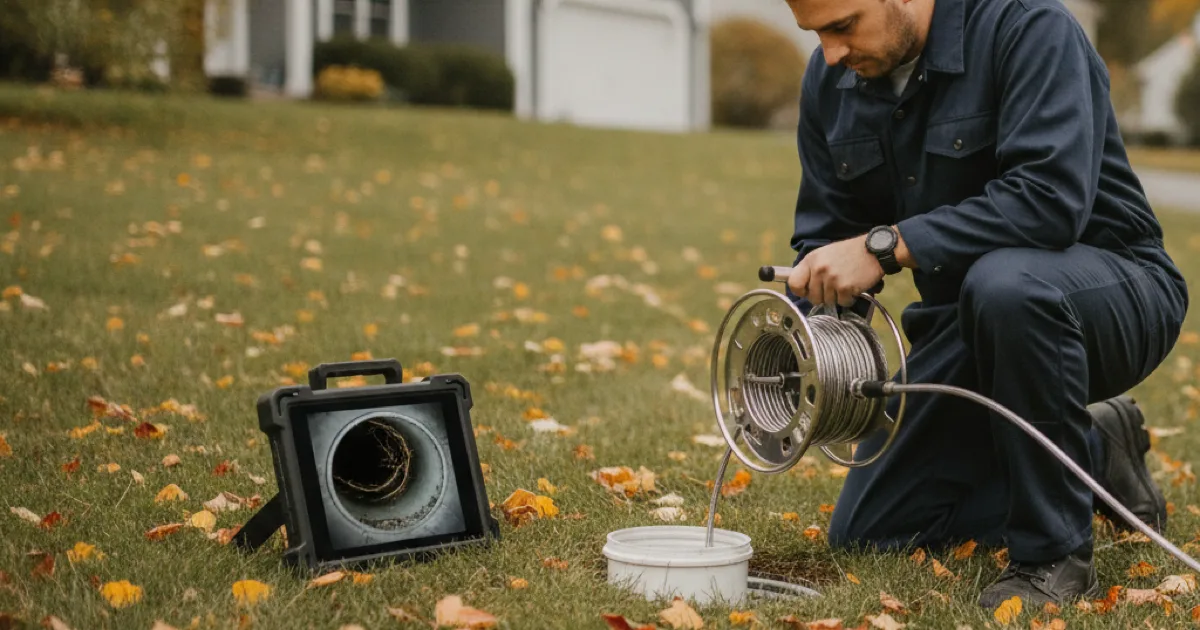
When a blockage keeps returning, the useful next step is camera inspection of the line rather than clearing it a third time — roots, a crack, or a settled section all look identical from the cleanout and need different fixes. If the camera finds real damage, then repairing a damaged sewer line is its own job with its own decisions about access and excavation.
On the groundwater side of what is still genuinely plumbing, we handle sump pump installation and replacement, sized for how much water a basement actually takes rather than whatever was there before. And for restaurants and small commercial kitchens, commercial grease trap cleaning keeps the trap doing its job instead of passing grease into the line.
Plenty of homes in this county aren’t on municipal sewer at all, and slow drains throughout the house can be the tank rather than the pipe. That’s worth ruling out early, so septic-connected drainage issues are handled as their own thing rather than treated as an ordinary clog.
Not sure which of those you need?
That’s normal. Tell us the symptoms and we’ll narrow it down.
How we work out what’s actually wrong
Drainage problems are one of the easier areas to get sold work you didn’t need, because the pipe is hidden and you have to take someone’s word for what’s in it. Our approach is to narrow things down in the cheapest order that still gets a real answer.
- Which fixtures, and in what order. One slow sink is a branch line. Several fixtures, or the lowest drain in the house acting up first, points downstream. This costs nothing and rules out a lot.
- Sewer or septic. It changes what’s likely and what we check next, so we establish it early.
- History. A line that’s been cleared repeatedly in the same spot is telling you something a fresh clearing won’t.
- Clear it, and look at what comes out. Grease, roots, wipes, or broken pipe are four different conversations about what happens next.
- Camera, only if it will change the decision. If we already know what to do, an inspection is just an extra line on your bill. If the answer would change the plan, it’s worth every penny.
We’ll tell you what we found, including when what we found is “nothing much, and you don’t need us again for a while.”
What makes drainage here its own thing
A few things about this county shape what we find in the ground.
Old laterals under mature trees
The sewer lateral running from house to street is often as old as the house, and in older neighbourhoods that means clay or early cast iron. Add the mature trees this area is known for, and root intrusion at pipe joints becomes a slow, seasonal, recurring pattern rather than a one-off blockage.
A real mix of sewer and septic
Within a few miles you can go from municipal sewer to septic and back. It genuinely changes the diagnosis: identical symptoms mean different things depending on which one you’re on, and treating a septic issue as a clogged pipe wastes a visit.
Freeze and thaw
Winter here works on buried pipe. Ground movement through repeated freeze and thaw cycles shifts joints on older lines, and shallow sump discharge lines freeze solid at exactly the wrong moment.
Storm-driven peaks
Heavy rain and spring thaw put water into the ground faster than it drains away, and that’s when a marginal system shows itself. Problems that were quietly there all year tend to surface within the same 48 hours across the county.
When it’s bigger than a cleaning
Sometimes clearing the line is treating a symptom. These are the signs the pipe itself needs attention:
- The same blockage returns in the same place within months.
- Cable goes through cleanly but flow doesn’t improve much.
- Repeated root material, in volume, from the same section.
- Sinkholes, soft ground, or unusually green grass along the lateral run.
- Sewage smell outside near the line rather than inside.
None of those mean you need immediate excavation. They mean the next sensible step is looking rather than clearing. We’d rather tell you a line has five more years in it than sell you a replacement today — and if it genuinely doesn’t, you’ll get that straight too, with the options laid out and the price before any work starts. You can also see the wider list of plumbing we take care of if the drainage problem turns out to be part of something larger in the house.
Common questions
Do you install French drains or fix yard drainage?
No — that’s excavation and landscape work rather than plumbing, and we’d rather say so than take the job. We handle everything inside the plumbing system, including the sump pump that often ends up dealing with the consequences of an outdoor drainage problem.
My basement is wet but the drains all work fine. Is that a plumbing problem?
Usually not, at least not initially. Water arriving through a wall or floor with no drainage symptoms is generally groundwater or surface water, which is a grading and exterior drainage issue. Where we come in is managing it once it’s inside — a properly sized sump system.
How do I know if I’m on septic or sewer?
If you get a sewer charge from your municipality, you’re on sewer. If there’s a tank lid or inspection cover somewhere in the yard, and you’ve had it pumped, you’re on septic. If you genuinely don’t know, we can usually tell within a few minutes of arriving.
Is a camera inspection worth paying for?
It is when the answer would change what happens next — recurring blockages, a suspected break, or before buying a house with mature trees over an old lateral. It isn’t when we’ve cleared a straightforward one-off clog and everything is flowing normally.
Everything drains slowly after heavy rain, then improves. Why?
That pattern usually means groundwater is getting into the system somewhere — a cracked lateral, a failed joint, or on septic, a field that saturates and can’t accept more. It’s worth investigating, because it tends to get worse rather than settle down.
Who is responsible for the sewer line under the street?
Generally the homeowner owns the lateral from the house to the main, including the portion under the road, though it varies by municipality here. It’s worth knowing before there’s a problem, and we can point you at who to ask in your town.
Let’s find out what’s really going on
Licensed, insured, and straight with you — including when the job belongs to someone else.