Grease Trap Cleaning in Westchester County, NY
A neglected trap doesn’t just smell. It puts grease into your lateral, and a blocked line during service is a far more expensive afternoon than a scheduled cleaning.
- Licensed & Insured
- Upfront Pricing
- Residential & Light Commercial Plumbing
- Clean, Respectful Technicians
What the trap is actually doing
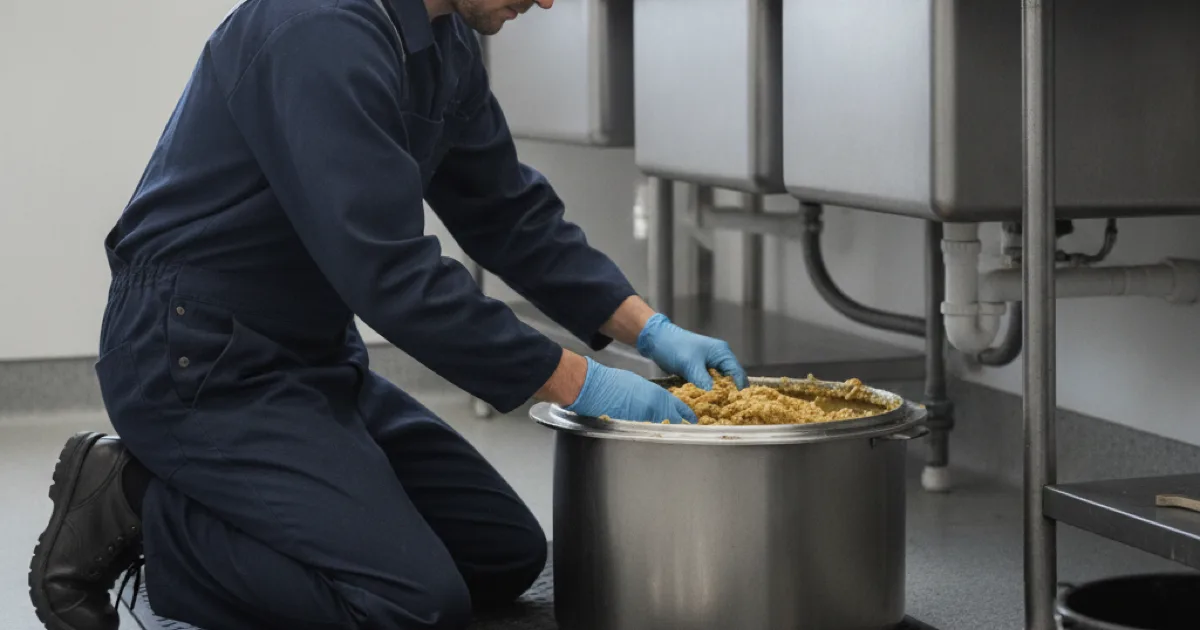
A grease trap is a simple device doing one job: slowing waste water down enough that fats, oils, and grease have time to separate out and float, while solids sink, so that what leaves toward the sewer is mostly water.
It works because grease is lighter than water and because the trap gives it time. That’s also why it stops working. As the floating layer thickens and the settled layer builds, the space left for water to move through shrinks, and the flow speeds up. Past a certain point grease passes straight through without separating.
The trap can look like it’s functioning right up until it isn’t, because the kitchen drains normally the whole time. The consequence shows up further along the line, usually at the worst possible moment.
Trap overdue, or kitchen draining slowly?
Better to sort it on a quiet morning than mid-service.
How often it needs servicing
The general rule used across the industry is that a trap should be cleaned before the combined grease and solids reach about a quarter of its total capacity. How long that takes depends entirely on your kitchen.
What actually drives the interval:
- Trap size relative to the kitchen. A small under-sink interceptor in a busy kitchen fills far faster than an in-ground unit sized for the volume.
- What you cook. A fryer-heavy menu loads a trap several times faster than a mostly cold or baked one.
- Covers and volume. More meals, more grease. Straightforward.
- Whether staff scrape before washing. This makes a genuine difference, and it’s free.
Your municipality may also set requirements for grease trap maintenance and record-keeping, and those vary between towns here. It’s worth knowing what applies to your premises rather than finding out during an inspection. The EPA’s guidance on keeping fats, oils, and grease out of the sewer system covers the practical side, including the kitchen habits that extend the interval.
What happens when it’s left
The failure sequence is fairly predictable, and each stage costs more than the last.
- Smell. The first sign, and the one most often treated as a ventilation problem rather than a trap problem.
- Slow drainage at kitchen fixtures, gradually rather than suddenly.
- Grease carrying over into your lateral, where it cools and coats the pipe wall along its length.
- A blocked line. This is the expensive one, because it happens under load — during service, with a full kitchen — and closing to deal with it costs more than the plumbing does.
Once grease has carried over, cleaning the trap alone won’t fix the line, because the coating is already in the pipe. That’s usually a jetting job rather than a cabling one. Grease trap work sits within our full drainage service list, so if the problem has already moved downstream we can deal with both rather than sending you to someone else halfway through.
What affects the cost and schedule
Grease trap cleaning is priced on the size and type of trap and how often it needs doing, which depends entirely on your kitchen. A small under-sink interceptor in a busy kitchen fills far faster than an in-ground unit sized for the volume.
We schedule around your service times rather than through them, and can advise on an interval that keeps you compliant and out of trouble without paying for cleanings more often than the trap actually needs.
Staying compliant
Your municipality may set requirements for grease trap maintenance and record-keeping, and those vary between towns here. Falling behind can mean penalties or a failed inspection at a bad moment.
We help small food businesses stay on top of the plumbing side of that — keeping the trap doing its job and the paperwork current — rather than discovering a lapse when an inspector arrives. Keeping grease out of the line in the first place is far cheaper than the blocked line and closed kitchen it eventually causes.
Common questions
Do grease trap additives work?
Enzyme and bacterial products can reduce odour, but they don’t remove accumulated grease and solids — only physically cleaning the trap does. Worse, some emulsify grease so it passes through the trap and re-solidifies further along the line, which moves the problem rather than solving it.
Can my staff clean it themselves?
For a small under-sink interceptor, some operators do handle routine cleaning in-house. It’s unpleasant work, waste disposal has rules attached, and record-keeping may be required where you are. Larger in-ground units are not a DIY job.
Does a home kitchen need a grease trap?
Almost never. Residential kitchens don’t produce the volume that makes a trap necessary. If a home kitchen line is clogging with grease, the answer is usually cleaning the line and changing what goes down it.
How long does a cleaning take?
A small interceptor is usually quick. Larger units take longer. Either way we’ll schedule around your service times rather than through them.
Will the kitchen smell afterwards?
Briefly during the work, honestly. Afterwards it should smell considerably better than before — a lingering smell is one of the more reliable signs a trap is overdue.
Keep the kitchen running
Licensed, insured, and scheduled around your service, not through it.