Hydro Jetting in Westchester County, NY
Jetting scours a pipe back to its full diameter instead of boring a hole through what’s inside it. It’s the right answer for some lines and the wrong one for others — we’ll tell you which yours is.
- Licensed & Insured
- Upfront Pricing
- Clean, Respectful Technicians
- 15+ Years of Experience
How jetting differs from cabling
A drain cable is a mechanical tool. It pushes through a blockage and, with the right head, cuts it apart. It’s fast, effective, and the right first choice for most clogs.
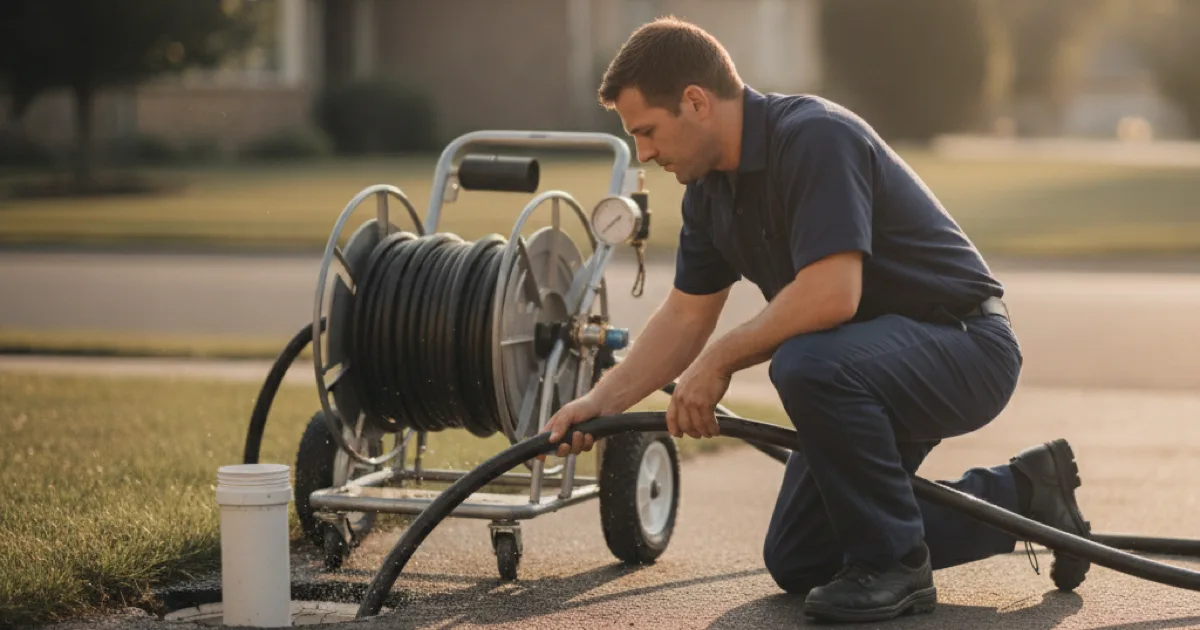
Jetting works differently. A high-pressure hose with a rearward-facing nozzle is fed down the line, and the water does two jobs at once: it cuts forward through the obstruction, and the backward jets pull the hose along while scouring the pipe wall as it goes. What comes out is flushed toward the cleanout rather than left in place.
The practical difference is what’s left behind. Cabling reopens a channel. Jetting takes the pipe back to something close to its actual internal diameter. On a line that’s coated along its length rather than plugged at one point, that difference decides whether you’re calling someone again in three months.
Same drain, over and over?
That pattern usually means coating rather than a clog.
When it’s worth it
Jetting earns its cost in a few specific situations:
- Grease-coated kitchen and restaurant lines. Grease builds as a layer on the pipe wall, which is exactly what a cable passes straight through. This is the clearest case for jetting.
- Lines that re-clog on a schedule. If the same drain backs up every few months, the pipe is telling you the previous clearing left the cause in place.
- Fine root hair after a cut. Cutting roots with a cable leaves the fine material behind; jetting flushes it out so regrowth starts from further back.
- Sand, silt, and scale that has settled along a low section and won’t move mechanically.
- Before a camera inspection, when a coated line needs cleaning before anyone can actually see its condition.
For a straightforward one-off blockage — hair in a bathroom trap, something dropped down a toilet — routine drain clearing is quicker and cheaper, and we’ll say so rather than reaching for the bigger machine.
When we’d talk you out of it
Jetting puts real pressure into a pipe, and not every pipe should receive it. This matters more here than in newer housing stock, because plenty of homes in this county still have their original waste lines.
- Old, heavily corroded cast iron. Where the pipe wall has thinned badly, pressure can find the weak spot. Sometimes the responsible answer is a gentler clearing and a conversation about replacement.
- Clay lines with shifted or open joints. Jetting can push water out through a failed joint into the surrounding soil rather than down the line.
- A pipe that’s already collapsed or badly bellied. No amount of cleaning fixes a structural problem, and jetting a broken line is money spent on a symptom.
- Anywhere we haven’t established what the pipe is. If the line’s material and condition are unknown and the history suggests problems, looking first is the cheaper order of operations.
That last point is the honest one. Where there’s doubt about a line’s condition, we’d rather run a camera first than jet blind — it’s a smaller bill than repairing a pipe we opened up. Jetting sits within our wider drain and sewer services, and the point of having several tools is using the right one. If you’re curious about the maintenance side, Family Handyman has a practical rundown of what actually keeps household drains clear between professional visits.
What affects the cost
Jetting is priced on the line and access, and we tell you the number before starting. A cleanout that gives a straight run at the blockage is quicker than a line that has to be reached awkwardly.
Where a line’s condition is unknown and its history suggests problems, we may recommend a camera first rather than jetting blind — a smaller bill than repairing a pipe we opened up. The point of having several tools is using the right one, not the most expensive one.
Keeping a line clear
A jetted line stays clear far longer than a cabled one when coating was the problem, because the cause has been removed rather than bypassed. If a structural defect is still there, though, it will return regardless of how well the line was cleaned.
For a line with a known history — a grease-heavy kitchen, or roots in a lateral — periodic jetting is cheaper than the blocked line it prevents. For an ordinary household drain, there is usually no need for a schedule at all.
Common questions
Will jetting damage my pipes?
Not in sound pipe, at appropriate pressure. In badly corroded cast iron or clay with failed joints, it can. That’s exactly why we assess the line before deciding, rather than treating jetting as the default upgrade.
How long does a jetted line stay clear?
Considerably longer than a cabled one, when coating was the problem — because the cause has been removed rather than bypassed. If there’s a structural defect still there, though, it’ll come back regardless of how well it was cleaned.
Is it messy?
Less than people expect. The work happens through a cleanout and the debris flushes down the line. We put down protection and clean up regardless.
Do I need jetting or just a regular cleaning?
If it’s a first-time clog in one fixture, regular cleaning. If it’s a recurring problem, a kitchen or restaurant line, or a whole-house slowdown, jetting is worth discussing. We can usually tell from the history over the phone.
Can jetting clear tree roots for good?
It clears them thoroughly, but roots regrow toward the same opening because the opening is still there. Jetting buys real time; permanently solving it means addressing the defect the roots are entering through.
Let’s get that line properly clear
Licensed, insured, and honest about which tool your pipe needs.