Sewer Camera Inspection in Westchester County, NY
You shouldn’t have to take anyone’s word for what’s inside a pipe you can’t see. A camera turns an opinion into something you can look at yourself.
- Licensed & Insured
- Upfront Pricing
- Clear Explanations Before Work Begins
- Locally Owned & Operated
When an inspection is worth paying for
We’ll say this plainly, because it’s easy to sell inspections people don’t need: a camera is worth it when the answer would change what happens next. If it wouldn’t, it’s just an extra line on your bill.
Worth it:
- A blockage that keeps returning to the same spot.
- Before any excavation, so digging happens in one place rather than exploratory ones.
- Buying a house, especially an older one with mature trees over the lateral.
- After a backup you don’t understand, where nothing obvious came out of the line.
- When a previous contractor has recommended a large job and you’d like to see it for yourself.
Not worth it:
- A straightforward one-off clog that cleared normally and hasn’t come back.
- A single slow fixture with no history, where the problem is in the trap.
- Routine maintenance on a line that’s never given trouble.
There’s one practical limit worth knowing: a heavily coated line has to be cleaned before a camera can see anything useful. If we’re inspecting a line like that, cleaning comes first — otherwise you’re paying to look at the inside of the grease.
Been told you need a big repair?
Get a look at the pipe before committing to anything.
Buying a house? This is the one to ask for
A standard home inspection does not include a sewer scope. It’s a separate service, it’s usually inexpensive relative to what it protects you from, and around here it’s one of the more sensible things a buyer can spend money on.
The reason is the housing stock. Plenty of properties in this county are old enough to still have clay or early cast iron laterals, and the mature trees that make a street attractive are directly above them. A failing lateral is invisible during a walkthrough, works fine under the light use of an empty or lightly occupied house, and becomes your problem the day you move a family in.
InterNACHI, the home inspectors’ association, explains what a sewer lateral inspection covers and why it sits outside a standard inspection — useful reading if you’re deciding whether to add one before closing.
If we find something, you have real options: negotiate, ask for it to be addressed before closing, or budget for it knowingly. All three are better than discovering it afterwards.
What we’re actually looking at
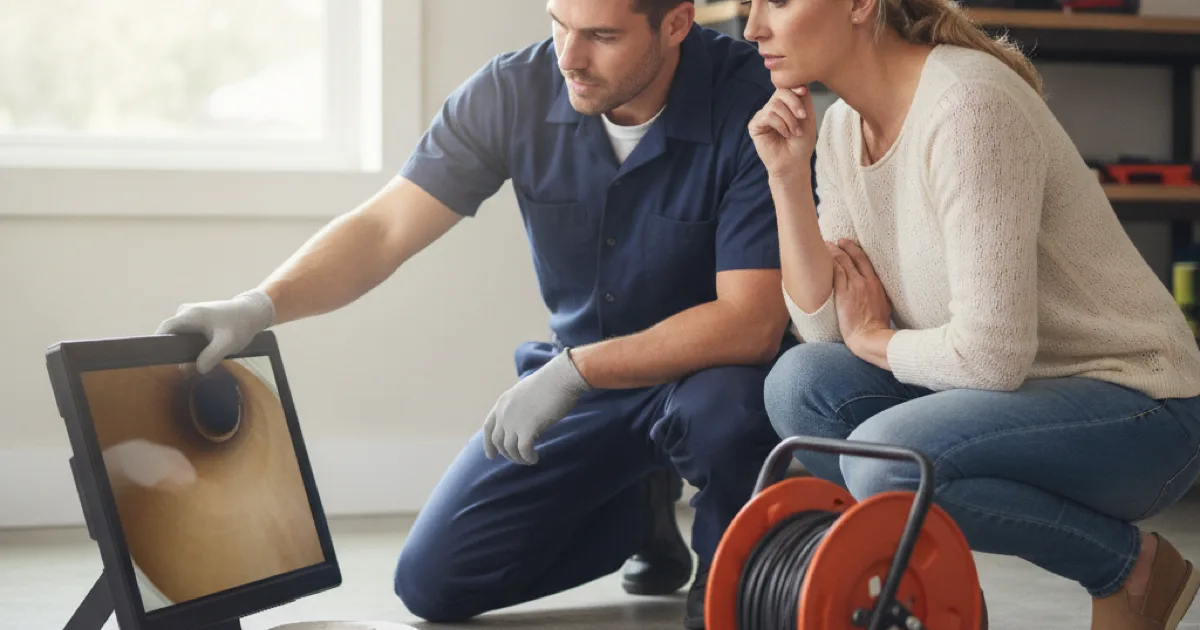
The camera goes in through a cleanout and runs the length of the line. You can watch as we go, and we’ll explain what’s on screen rather than narrating it afterwards.
The things that matter:
- Root intrusion — where it’s entering, how much, and how far along the run.
- Cracks and separated joints, including whether soil is visible through them.
- Bellies — a settled section holding standing water, which will keep collecting debris in the same place forever.
- Scale and buildup, and whether the pipe is near its proper diameter or well under it.
- Pipe material and condition, which largely determines whether repair or replacement is the honest recommendation.
- Collapse or offset — where a section has failed structurally or shifted out of line.
Where a locator is useful, we can also mark the depth and position of a problem on the surface, which is what turns a general “somewhere out front” into a specific spot to open. That detail is the difference between a targeted excavation and a hopeful one, and it feeds directly into repairs once we find the break.
Plenty of inspections end with good news, and we’ll tell you that just as readily. Camera work is one part of the rest of our drainage work, and its job is to make the decision obvious rather than to justify a bigger one.
What it costs, and what you get
A camera inspection is priced as its own service, and it is usually inexpensive relative to what it can save you from — particularly before buying an older house. We give you the number upfront.
One practical point: a heavily coated line has to be cleaned before a camera can see anything useful, so if we are inspecting a line like that, cleaning comes first. Otherwise you are paying to look at the inside of the grease.
What happens after the inspection
Plenty of inspections end with good news, and we will tell you that just as readily as a problem. Where we do find something, you get a clear picture of what it is and where, and honest options rather than an automatic push to the biggest repair.
If we locate a specific defect, we can mark its depth and position on the surface, which turns a general “somewhere out front” into a precise spot to open — the difference between a targeted repair and a hopeful excavation.
Common questions
Do I get a copy of the footage?
Ask and we’ll sort it out. It’s genuinely useful if you’re negotiating a house purchase, comparing quotes, or simply want a record of the line’s condition to compare against in a few years.
Is a sewer scope included in a home inspection?
No — it’s a separate service, and standard inspections don’t cover it. On an older property with mature trees, it’s worth adding.
Can the camera go through any pipe?
It needs a suitable access point, and very small branch lines are too narrow for a sewer camera. Main lines and larger branches are generally fine. If access is the obstacle, we’ll tell you before booking rather than after arriving.
What if the camera can’t get all the way through?
That is itself a finding. A camera stopping at a consistent point usually means an obstruction, a collapse, or a severe offset right there — which tells us where to focus.
How long does an inspection take?
Usually under an hour for a typical residential lateral, assuming there’s an accessible cleanout and the line doesn’t need cleaning first.
See it for yourself
Licensed, insured, and happy to show you the screen.