Sump Pump Installation in Westchester County, NY
A sump pump is only as good as the sizing behind it. We look at how much water your basement actually takes on before recommending anything — not after.
- Licensed & Insured
- Upfront Pricing
- 15+ Years of Experience
- Clean, Respectful Technicians
Basement taking on water?
Tell us what you’re seeing and we’ll tell you what it needs.
Does a sump pump mean something’s wrong with the house?
This is the question we get asked most, usually by someone who just had a home inspection or is about to list. The short answer is no.
In this part of Westchester, a sump pump is closer to standard equipment than a warning sign. The soil here holds water — a lot of the county sits on dense, clay-heavy glacial till over shallow bedrock. Rain doesn’t soak away downward the way it does in sandier ground. It moves sideways until it finds a foundation, and then it sits against it.
A basement below that water level will take on water at some point, regardless of how well the house was built. A sump pump is simply the accepted way of giving that water somewhere to go.
What would be a red flag is a pump that’s clearly working hard year-round in a house with no other drainage, an obviously improvised discharge arrangement, or a basin that’s been cut in as an afterthought to deal with a problem nobody diagnosed. Those tell you something. The presence of a properly installed pump doesn’t.
How we install one
A first-time installation and a straight replacement are different jobs, so it’s worth knowing which one you’re actually looking at.
Replacing an existing pump
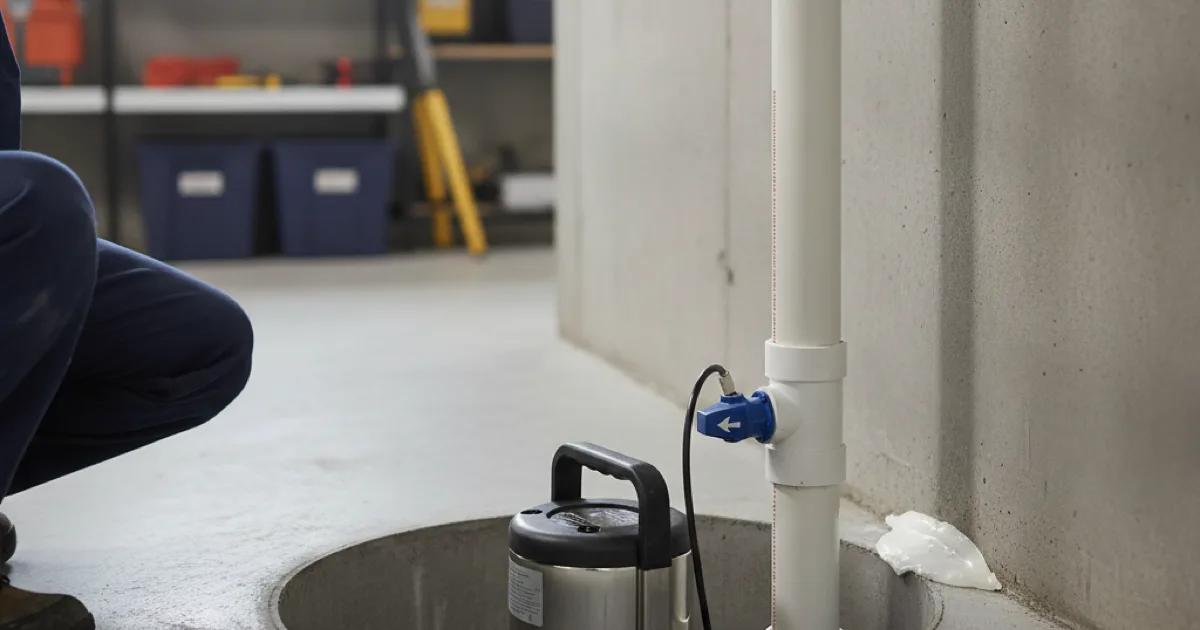
If there’s already a basin in the floor, this is usually straightforward. We check that the existing basin is sound and the right depth, replace the pump and check valve, inspect the discharge line for the problems that shorten pump life, and test it by filling the basin rather than just lifting the float by hand.
Installing where there’s never been one
This is a bigger job. It means cutting through the basement slab at the low point, digging out and setting a basin, backfilling with gravel so water can actually reach it, and re-finishing the concrete around it. Then the discharge line has to get outside and far enough from the foundation that the water doesn’t simply come back.
- Find the real low point. Not always where the water pools — slabs settle unevenly, and the wet patch is sometimes just where it surfaces.
- Cut and excavate the basin. Depth matters here. Too shallow and the pump short-cycles itself to death.
- Set the basin in gravel. The gravel is what lets groundwater move into the basin instead of collecting under the slab.
- Fit the pump, check valve, and discharge. The check valve stops the column of water in the pipe falling back into the basin every time the pump shuts off.
- Run the discharge properly. Away from the foundation, not into a septic system, and not somewhere it freezes solid in January.
- Re-finish the slab and test under real load.
If the water arriving in your basement is also showing up as drains that back up during the same storms, those two things are usually related, and worth looking at together rather than separately.
Not sure if yours needs replacing?
We’ll test what’s there before recommending a new one.
Sizing it for your basement, not a catalogue
Most sump pumps that fail early weren’t bad pumps. They were the wrong pump for that basement.
Two things decide what you need: how much water arrives during a bad storm, and how high the pump has to lift it to get it outside. A pump rated for a certain flow at three feet of lift moves considerably less at ten feet, which is why a pump that looks adequate on the box can struggle in a deep basement.
Beyond that, the choices worth thinking about:
- Submersible or pedestal. Submersible sits in the basin, runs quieter, and handles more water. Pedestal keeps the motor above the water and is easier to service. In a finished basement, the noise difference matters more than people expect.
- Cast iron or plastic housing. Cast iron sheds heat into the surrounding water, so it runs cooler and generally lasts longer where the pump cycles frequently.
- Battery backup. Worth serious thought here. The storms that bring the most water are the same storms that take the power out, and a mains-only pump is doing nothing precisely when you need it most.
- Float type. Tethered floats need room to swing; in a narrow basin a vertical float is more reliable.
FEMA’s guidance on protecting a property from flooding is a reasonable plain-English starting point if you want to understand the drainage side before deciding how much pump to buy.
What affects the cost
We give you the price before we start, and we’d rather explain what moves it than publish a number that turns out to be wrong for your house. These are the real variables:
- Replacement or new installation. The single biggest factor. Cutting a slab and setting a basin is a different scale of work from swapping a pump into an existing one.
- Where the discharge has to go. A short run to a sensible outfall is simple. Getting water far enough away on a tight lot, or around a finished space, is not.
- Backup power. A battery backup system adds real cost, and is genuinely optional — we’ll tell you whether your situation warrants it rather than adding it by default.
- Access. An open utility area is quicker to work in than a finished room where we’re protecting flooring and working around what’s already there.
- What we find underneath. Occasionally a slab hides something nobody expected. If that happens we stop and re-quote before continuing.
If a sump pump is going in as part of a larger project, it’s usually cheaper to do the related work at the same time while the floor is already open. Have a look at other plumbing jobs we take on and mention anything else you’ve been putting off when you call.
How long it lasts, and keeping it alive
A sump pump is a motor that runs unattended in water, in the dark, in a part of the house nobody visits. Roughly seven to ten years is a fair working expectation, but that varies enormously with how often it cycles. A pump in a wet basement doing several cycles an hour through spring will not last as long as one that runs a handful of times a year.
Three things shorten a pump’s life more than anything else:
- Short-cycling. A basin too small or a float set too tight means the pump starts and stops constantly. Motor starts are what wear it out, not running time.
- A failed check valve. When it goes, the water in the discharge pipe drops back into the basin after every cycle, so the pump immediately pumps the same water again. Easy to fix, easy to miss.
- A frozen or blocked discharge. The pump keeps running against a closed pipe until it burns out. Worth checking before winter — the same cold snaps that cause cold-weather plumbing problems elsewhere in the house will freeze a shallow discharge line solid.
Two minutes of maintenance a couple of times a year covers most of it: pour a bucket of water into the basin and confirm the pump kicks on, pumps out, and shuts off cleanly. If it hums without moving water, or runs on after the basin is empty, call before the next storm rather than during it. Sump pumps are one piece of how we handle drainage overall, and they work best alongside gutters and grading that aren’t delivering water to your foundation in the first place.
Common questions
How much should I expect to pay for a sump pump installation?
It depends most on whether there’s already a basin in the floor. A replacement into an existing basin is a modest job; a first-time installation involves cutting the slab and is substantially more. We’ll look at your basement and give you the actual number upfront rather than a range that doesn’t mean anything.
Who should install a sump pump — a plumber or a waterproofing company?
For the pump, basin, check valve, and discharge, a licensed plumber is the right call, and it’s work we do regularly. If the underlying issue is the foundation itself — structural cracks, or a full perimeter drainage system — that’s a waterproofing contractor’s job. We’ll tell you honestly which one you’re looking at.
Do I need a battery backup?
If your basement is finished, or you’ve had water during a storm that also knocked the power out, it’s worth it. If your pump runs a few times a year in an unfinished basement, probably not. It’s the storms that bring water and cut power at the same time that make the case.
Can the discharge go into my septic system?
No. Groundwater sent into a septic system floods the tank and field and can cause a much more expensive failure than the one you were trying to solve. It also isn’t permitted. The discharge needs to go to the surface, well away from the foundation.
My pump runs constantly in spring. Is that normal?
Frequent running during the thaw and heavy spring rain is normal here. Constant running in a dry week is not — that usually means a failed check valve, a float stuck in position, or groundwater arriving from somewhere that needs looking at.
Will you have to break up my basement floor?
Only if there’s no existing basin. When we do, it’s a contained cut at the low point rather than a large area, and we re-finish the concrete around the new basin before we leave.
Let’s get your basement sorted
Licensed, insured, and local — with a straight answer about what your basement actually needs.