Water Heater Installation in Westchester County, NY
We’ll tell you what your house actually needs — including when the cheaper option is the right one. Sized properly, installed to code, price agreed before we start.
- Licensed & Insured
- Upfront Pricing
- Same-Day Service Available
- Clear Explanations Before Work Begins
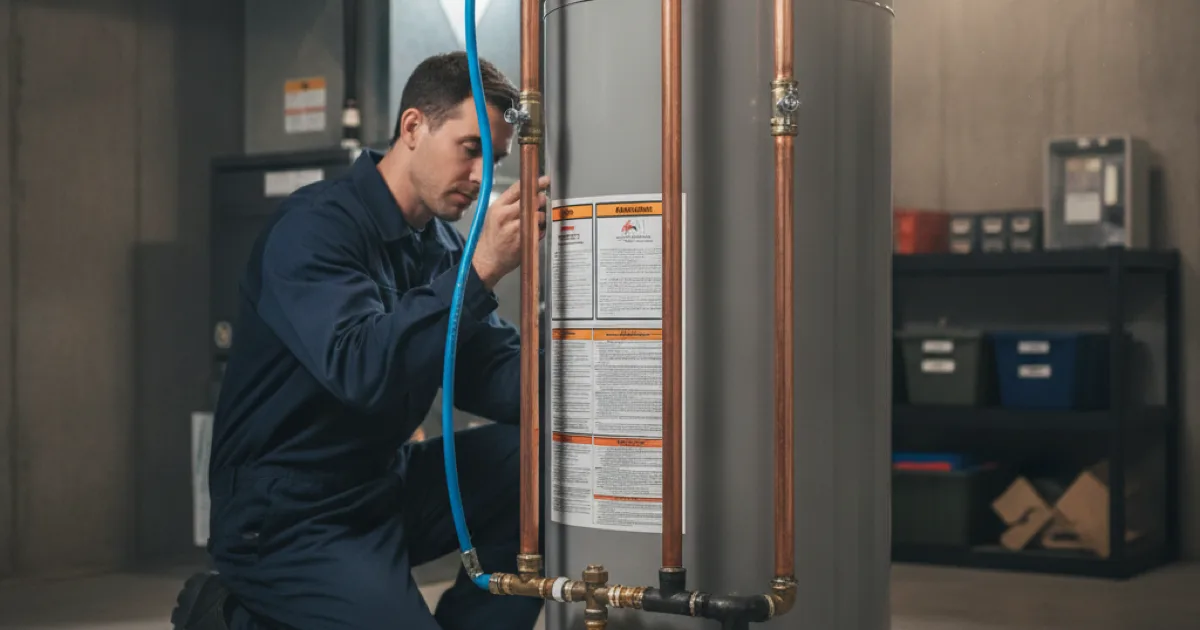
Tank or tankless, honestly
Plenty of companies around here lead with tankless, because it’s the bigger sale. It’s genuinely a good option for some houses. It’s a poor one for others, and the difference usually comes down to what’s already in your basement.
Where a tank still makes sense
A conventional tank is cheaper to buy, cheaper to install, and simpler to repair. If your existing setup is a tank, the gas line and venting already suit it, and your household’s hot water use is fairly ordinary, replacing like for like is often the sensible answer. There’s nothing old-fashioned about it.
Where tankless earns its cost
Tankless makes real sense when you’re short on space, when you’re genuinely running out of hot water with a tank that’s already correctly sized, or when you plan to stay in the house long enough for the efficiency to pay back the higher install cost.
The part that gets left out
In older Westchester homes, switching from tank to tankless is often not just a swap. A tankless unit fires at a much higher input than a tank, which frequently means upsizing the gas line to suit it, and it needs its own venting rather than sharing an existing chimney flue. Those two things can add meaningfully to the job.
None of that makes tankless a bad choice. It just means the honest comparison isn’t unit price against unit price. We’ll look at what your house already has and tell you what the real difference works out to, then let you decide. If you’ve already weighed it up and know you want going tankless instead, that’s work we do regularly.
How the installation goes
A straight tank replacement is usually a same-day job. Here’s what it involves, so nothing about the day is a surprise.
- Shut down and drain the old unit. Gas or power off first, water off, then the tank is drained — the slowest part of the whole job, and unavoidable.
- Disconnect and remove it. Old heaters are heavy and full of sediment. We protect floors and stairs on the way out.
- Check what it was connected to. This is where problems surface: corroded shut-off valves, undersized or deteriorated venting, missing expansion tanks, connections that were never right. We show you anything we find before touching it.
- Set and connect the new unit. New flex connectors or hard piping, a new shut-off if the old one is suspect, correct venting, and a temperature and pressure relief valve piped properly to the floor.
- Fill, purge, and fire it. Air has to come out of the lines before it heats, or the unit runs dry and damages itself.
- Test and clean up. We check for leaks at every joint, confirm the temperature at a tap, and take the old unit with us.
If the heater is still working but not well, replacement isn’t automatically the answer — a thermostat, a heating element, or a thermocouple is a much smaller job, and repairing the heater you already have is worth considering when the tank itself is sound.
Want a straight recommendation?
Tell us what you have and how many people are in the house.
Getting the size right
Sizing a tank isn’t really about how many gallons it holds. It’s about how much hot water it can deliver during your busiest hour — usually a weekday morning with showers, a dishwasher, and laundry overlapping.
That figure is called first-hour rating, and it’s a better guide than tank volume, because a smaller tank that recovers quickly can outperform a bigger one that heats slowly. For tankless, the equivalent question is flow rate: how many fixtures you need running at once, and how cold the incoming water is. Groundwater here is properly cold in winter, which reduces what a tankless unit can deliver at exactly the time of year you notice it.
The Department of Energy’s guidance on sizing a new water heater walks through the same calculation we use, if you want to sanity-check any recommendation you’re given — ours included.
The two failure modes we see most: a tank undersized for a household that grew, and a tank oversized by someone who thought bigger was safer, which just means standing heat loss you pay for every month.
Permits and inspection in New York
This is the part almost nobody mentions until the invoice, so here’s the plain version.
Replacing a water heater is regulated work. Municipalities across Westchester generally require a permit for a water heater replacement, and gas work in particular is inspected. Requirements and fees vary from one town or village to the next — Armonk, Mount Kisco, and Yonkers do not all handle it identically — so the right answer depends on where your house actually is.
Two things follow from that. First, a quote that looks unusually cheap sometimes turns out to be a quote for unpermitted work. That can matter later: an uninspected gas appliance is the kind of thing that surfaces during a home sale or an insurance claim, at the worst possible moment.
Second, we handle the permitting side as part of the job and tell you upfront what your municipality requires, rather than leaving you to discover it. We’re licensed in Westchester County, which is what allows that work to be permitted and signed off properly.
What affects the cost
We give you the price before we start, and it doesn’t move unless we find something and agree a change with you first. These are the things that actually drive it:
- Tank or tankless. The largest single factor, and not only because of the unit — see the gas and venting note above.
- Gas, electric, or indirect. Each has different connection requirements, and swapping fuel type is a bigger job than staying with what’s there.
- Capacity. A larger unit costs more and sometimes needs different clearances around it.
- What we find at the connections. Corroded valves, poor venting, or a missing expansion tank are common on older installs and need putting right rather than reconnecting to.
- Access. A tight basement stairway or a crawlspace location genuinely adds time.
- Permit and inspection fees for your municipality.
We don’t publish prices here, because a number that isn’t based on your actual setup would be a guess. Call and describe what you have — that’s usually enough for a realistic figure before anyone visits. It’s also worth glancing at the other work we handle in Westchester homes if there’s anything else you’ve been meaning to sort while we’re there.
Common questions
How long does a water heater installation take?
A straight tank-for-tank replacement is usually a few hours, and often same-day. Converting to tankless, changing fuel type, or relocating the unit takes longer — sometimes more than a day if gas or venting work is involved. We’ll tell you which one you’re looking at before we book it.
Do I need a permit to replace a water heater?
In most Westchester municipalities, yes — and gas work is generally inspected. The specifics vary by town or village, so we confirm what applies at your address and handle it as part of the job rather than leaving it to you.
How long should a water heater last?
A conventional tank commonly runs somewhere in the ten-to-fifteen year range, and tankless units generally longer. Water quality and whether the anode rod was ever checked make a real difference. If yours is past that range and working fine, there’s no need to rush — but it’s worth planning rather than waiting for it to fail on a Sunday.
Can I buy the heater myself and have you fit it?
Usually, yes. Worth knowing first: manufacturer warranties often differ between units sold to trade and units sold retail, and if the one you bought turns out to be the wrong size or the wrong venting type, that becomes an awkward day. Talk to us before you buy and we’ll tell you whether it fits.
There’s water under my heater. Is it definitely finished?
Not necessarily. Water underneath can come from the relief valve, a loose fitting, or condensation, and those are repairs rather than replacements. If it’s weeping from the tank body itself, though, that can’t be fixed and the unit needs replacing before it lets go properly.
Will a bigger tank fix running out of hot water?
Sometimes, but not always. If the tank is the right size and you’re still running short, the cause is often a failing lower element, heavy sediment, or a mixing valve problem — all cheaper to fix than to replace. Worth checking before buying more capacity you may not need.
Ready for reliable hot water?
Licensed, insured, and straight with you about what your home actually needs.